
PARAMETRIC · 3D · STEP / STL / 3MF
Button Head Screw M8 × 20BUTTON HEAD SCREW
Free STEP, STL and 3MF download of a button head screw M8 × 20 with live 3D preview. Key dimensions: Pitch 1.25 mm, Pitch diameter 7.188 mm, Minor diameter 6.466 mm, Tap drill 6.80 mm. Every parameter stays adjustable, and you can send it straight to Orinovate for printing.
- StandardISO 7380-1
- SizesM3–M16
- HeadLow dome
- OutputSTEP · STL · 3MF · DXF
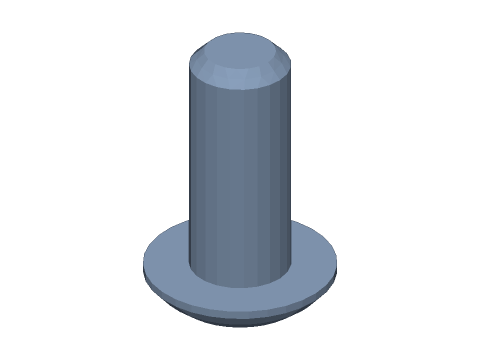
LIVE · BUTTON HEAD SCREW
M8 × 20
SCALE 1:1 · mm
Drag to rotate · scroll to zoom · right-drag to pan
CALCULATED · SPEC
AUTO-COMPUTED
P
1.25mm
Pitch
d2
7.188mm
Pitch diameter
d3
6.466mm
Minor diameter
⌀
6.80mm
Tap drill
dh
8.4 / 9mm
Clearance hole (fine / medium)
dk
14.00mm
Head diameter
k
4.40mm
Head height
s
5.0mm
Hex key size
t
2.60mm
Socket depth
b
20.0mm
Thread length
L
24.40mm
Overall length (incl. head)
As
36.61mm²
Tensile stress area
Fm
29.3kN
Min. tensile load (class 8.8)
HOW-TO
How to generate a button head screw STEP / STL file
- 1Pick the thread size — head dimensions follow the standard automatically.
- 2Enter the length or tap a common length.
- 3Choose the thread mode: simplified for assemblies, modeled to see the thread, 3D-print for printing.
- 4Check the spec cards and any warnings.
- 5Download STEP, STL or 3MF — or send it to Orinovate for a quote.
What is a button head screw (ISO 7380)?
A button head socket screw has a low spherical head — about 1.75–1.9d in diameter and 0.55d high, much lower than a cap screw — for places without a counterbore where a smooth surface matters, like 2020 extrusion panels and printer enclosures. The model approximates the head with a spherical arc over a flat bearing face.
ISO metric thread formulas
The ISO 68-1 basic profile is a 60° triangle with fundamental height H = 0.866P. Pitch diameter d2 = d − 0.6495P, internal minor D1 = d − 1.0825P, external minor d3 = d − 1.2269P, tensile stress area As = π/4 × ((d2 + d3)/2)². For M8 (P = 1.25): d2 = 7.188, D1 = 6.647, d3 = 6.466 mm, As = 36.6 mm². Modeled threads are right-handed and faceted into 36 planar segments per turn (error < 0.4 % of the diameter).
Specs at default parameters
| Parameter | Value | Range |
|---|---|---|
| Thread size (d) | M8 | M3 / M4 / M5 / M6 / M8 / M10 / M12 / M16 |
| Length (l) | 20 mm | 1–200 |
| Thread mode | Simplified (no thread) | Simplified (no thread) / Modeled thread / 3D-print thread |
| Print clearance (c) | 0.15 mm | 0.05–0.5 |
| Pitch (P) | 1.25 mm | — |
| Pitch diameter (d2) | 7.188 mm | — |
| Minor diameter (d3) | 6.466 mm | — |
| Tap drill (⌀) | 6.80 mm | — |
| Clearance hole (fine / medium) (dh) | 8.4 / 9 mm | — |
| Head diameter (dk) | 14.00 mm | — |
| Head height (k) | 4.40 mm | — |
| Hex key size (s) | 5.0 mm | — |
| Socket depth (t) | 2.60 mm | — |
| Thread length (b) | 20.0 mm | — |
| Overall length (incl. head) (L) | 24.40 mm | — |
| Tensile stress area (As) | 36.61 mm² | — |
| Min. tensile load (class 8.8) (Fm) | 29.3 kN | — |
Popular button head screw sizes
FAQ
Button head vs socket head cap screw?
Button heads (ISO 7380) are low and rounded — tidy, snag-free, great for covers, extrusion panels and bike parts. Their socket is smaller (3 mm key for M5 vs 4 mm for a cap screw), so they take less torque, and ISO 7380 only goes up to class 10.9. Use ISO 4762 cap screws for high clamp loads.
Why is there no M14?
ISO 7380-1 only lists M3, M4, M5, M6, M8, M10, M12 and M16, and M14 button heads are practically unavailable, so the generator leaves it out.
What size hole for an M3 screw? Which tap drill?
Tap drill ≈ nominal diameter − pitch: M3 → 2.5 mm, M4 → 3.3, M5 → 4.2, M6 → 5.0, M8 → 6.8, M10 → 8.5, M12 → 10.2 mm. For a clearance hole (ISO 273): M3 3.2 (fine) / 3.4 (medium), M4 4.3 / 4.5, M5 5.3 / 5.5, M6 6.4 / 6.6, M8 8.4 / 9 mm. The spec cards list both for the selected size.
What do property classes 8.8, 10.9 and 12.9 mean?
Per ISO 898-1 the first number × 100 is the nominal tensile strength in MPa and the product of both numbers × 10 the nominal yield strength. The specified minimums are slightly higher: 8.8 (d ≤ 16) = 800 / 640 MPa, 10.9 = 1040 / 940 MPa, 12.9 = 1220 / 1100 MPa. Socket cap screws are usually 12.9, general hex bolts 8.8. Minimum breaking load = tensile strength × stress area As; the spec cards show it for class 8.8.
Do 3D-printed threads work?
Yes, from about M6 up — a 0.4 mm FDM nozzle can barely resolve an M3 thread (0.5 mm pitch). Use the 3D-print mode (external thread shrunk 0.15 mm, internal enlarged 0.2 mm, adjustable), print screws standing up with ≤ 0.12 mm layers. For parts that are assembled often or loaded, heat-set inserts or a captive hex-nut pocket last far longer than printed threads.
Which software opens the button head screw STEP file?
STEP (AP214) opens in Fusion 360, SolidWorks, FreeCAD, Onshape and Rhino. STL / 3MF import directly into Bambu Studio, PrusaSlicer or Cura.
Is it free?
Yes — no sign-up, no fees. Need a physical part? Send it to Orinovate for an instant quote in FDM, SLA, SLS, MJF or CNC.
Related generators
Related articles
Need a physical part?
Send the model straight to Orinovate's instant quote: FDM, SLA, SLS, MJF, metal printing and CNC, made in Hsinchu, Taiwan.
About STEP / STL / 3MF / DXF
- STEP (.step / .stp, AP214) keeps exact dimensions and surfaces for editing in Fusion 360, SolidWorks or FreeCAD.
- STL and 3MF are triangle meshes that import directly into Bambu Studio, PrusaSlicer or Cura.
- DXF is the top-view 2D outline, ready for laser cutting, waterjet or CNC routing.
- All models are in millimetres at true scale.