
PARAMETRIC · 3D · STEP / STL / 3MF
Ball Bearing 6906 · 30×47×9DEEP GROOVE BALL BEARING
Free STEP, STL and 3MF download of a ball bearing 6906 · 30×47×9 with live 3D preview. Key dimensions: Bore 30.00 mm, Outside diameter 47.00 mm, Width 9.00 mm, Chamfer 0.30 mm. Every parameter stays adjustable, and you can send it straight to Orinovate for printing.
- StandardISO 15 / JIS B 1512
- Sizes79
- ModelSimplified / detailed
- OutputSTEP · STL · 3MF · DXF
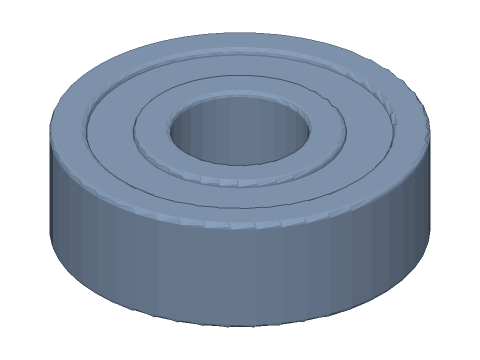
LIVE · DEEP GROOVE BALL BEARING
6906 · 30×47×9
SCALE 1:1 · mm
Drag to rotate · scroll to zoom · right-drag to pan
CALCULATED · SPEC
AUTO-COMPUTED
d
30.00mm
Bore
D
47.00mm
Outside diameter
B
9.00mm
Width
r
0.30mm
Chamfer
Dpw
38.5mm
Ball pitch diameter (est.)
Dw
4.93mm
Ball diameter (est.)
Z
15
Number of balls (est.)
HOW-TO
How to generate a ball bearing STEP / STL file
- 1Choose a bearing number, or “Custom” and enter d, D and B.
- 2Choose a simplified or detailed model.
- 3Check the spec cards and any warnings.
- 4Download STEP, STL or 3MF — or send it to Orinovate for a quote.
What is a deep groove ball bearing?
A deep groove ball bearing consists of an inner ring, an outer ring, balls and a cage running in deep circular-arc raceways. It carries radial loads plus moderate axial loads in both directions, with low friction and low cost — the most widely used rolling bearing. This tool includes ISO 15 / JIS B 1512 series 68, 69, 60, 62, 63 and common miniatures.
Choosing a size
The shaft sets the bore code; space and load set the series: 68/69 thin sections for tight spaces, 62 as the balanced default, 63 for the highest load. Ball size and count vary by maker; this tool estimates Dw ≈ 0.29 (D − d) with ~60 % ball fill on the pitch circle — for visuals and clearance checks only.
Specs at default parameters
| Parameter | Value | Range |
|---|---|---|
| Bearing number | 6906 (30 × 47 × 9) | 604 (4 × 12 × 4) / 605 (5 × 14 × 5) / 606 (6 × 17 × 6) / 607 (7 × 19 × 6) / 608 (8 × 22 × 7) / 609 (9 × 24 × 7) / 623 (3 × 10 × 4) / 624 (4 × 13 × 5) / 625 (5 × 16 × 5) / 626 (6 × 19 × 6) / 627 (7 × 22 × 7) / 629 (9 × 26 × 8) / 634 (4 × 16 × 5) / 635 (5 × 19 × 6) / 683 (3 × 7 × 3) / 684 (4 × 9 × 4) / 685 (5 × 11 × 5) / 686 (6 × 13 × 5) / 687 (7 × 14 × 5) / 688 (8 × 16 × 5) / 689 (9 × 17 × 5) / 693 (3 × 8 × 4) / 694 (4 × 11 × 4) / 695 (5 × 13 × 4) / 696 (6 × 15 × 5) / 697 (7 × 17 × 5) / 698 (8 × 19 × 6) / 699 (9 × 20 × 6) / 6000 (10 × 26 × 8) / 6001 (12 × 28 × 8) / 6002 (15 × 32 × 9) / 6003 (17 × 35 × 10) / 6004 (20 × 42 × 12) / 6005 (25 × 47 × 12) / 6006 (30 × 55 × 13) / 6007 (35 × 62 × 14) / 6008 (40 × 68 × 15) / 6009 (45 × 75 × 16) / 6010 (50 × 80 × 16) / 6200 (10 × 30 × 9) / 6201 (12 × 32 × 10) / 6202 (15 × 35 × 11) / 6203 (17 × 40 × 12) / 6204 (20 × 47 × 14) / 6205 (25 × 52 × 15) / 6206 (30 × 62 × 16) / 6207 (35 × 72 × 17) / 6208 (40 × 80 × 18) / 6209 (45 × 85 × 19) / 6210 (50 × 90 × 20) / 6300 (10 × 35 × 11) / 6301 (12 × 37 × 12) / 6302 (15 × 42 × 13) / 6303 (17 × 47 × 14) / 6304 (20 × 52 × 15) / 6305 (25 × 62 × 17) / 6306 (30 × 72 × 19) / 6307 (35 × 80 × 21) / 6308 (40 × 90 × 23) / 6309 (45 × 100 × 25) / 6310 (50 × 110 × 27) / 6800 (10 × 19 × 5) / 6801 (12 × 21 × 5) / 6802 (15 × 24 × 5) / 6803 (17 × 26 × 5) / 6804 (20 × 32 × 7) / 6805 (25 × 37 × 7) / 6806 (30 × 42 × 7) / 6807 (35 × 47 × 7) / 6808 (40 × 52 × 7) / 6900 (10 × 22 × 6) / 6901 (12 × 24 × 6) / 6902 (15 × 28 × 7) / 6903 (17 × 30 × 7) / 6904 (20 × 37 × 9) / 6905 (25 × 42 × 9) / 6906 (30 × 47 × 9) / 6907 (35 × 55 × 10) / 6908 (40 × 62 × 12) / Custom size |
| Bore (d) | 8 mm | 1–200 |
| Outside diameter (D) | 22 mm | 3–300 |
| Width (B) | 7 mm | 1–100 |
| Chamfer (r) | 0.3 mm | 0–5 |
| Detail | Simplified (one solid) | Simplified (one solid) / Detailed (rings + balls + shields) |
| Bore (d) | 30.00 mm | — |
| Outside diameter (D) | 47.00 mm | — |
| Width (B) | 9.00 mm | — |
| Chamfer (r) | 0.30 mm | — |
| Ball pitch diameter (est.) (Dpw) | 38.5 mm | — |
| Ball diameter (est.) (Dw) | 4.93 mm | — |
| Number of balls (est.) (Z) | 15 | — |
Popular ball bearing sizes
- 604 · 4×12×4
- 605 · 5×14×5
- 606 · 6×17×6
- 607 · 7×19×6
- 608 · 8×22×7
- 609 · 9×24×7
- 623 · 3×10×4
- 624 · 4×13×5
- 625 · 5×16×5
- 626 · 6×19×6
- 627 · 7×22×7
- 629 · 9×26×8
- 634 · 4×16×5
- 635 · 5×19×6
- 683 · 3×7×3
- 684 · 4×9×4
- 685 · 5×11×5
- 686 · 6×13×5
- 687 · 7×14×5
- 688 · 8×16×5
- 689 · 9×17×5
- 693 · 3×8×4
- 694 · 4×11×4
- 695 · 5×13×4
- 696 · 6×15×5
- 697 · 7×17×5
- 698 · 8×19×6
- 699 · 9×20×6
- 6000 · 10×26×8
- 6001 · 12×28×8
- 6002 · 15×32×9
- 6003 · 17×35×10
- 6004 · 20×42×12
- 6005 · 25×47×12
- 6006 · 30×55×13
- 6007 · 35×62×14
- 6008 · 40×68×15
- 6009 · 45×75×16
- 6010 · 50×80×16
- 6200 · 10×30×9
- 6201 · 12×32×10
- 6202 · 15×35×11
- 6203 · 17×40×12
- 6204 · 20×47×14
- 6205 · 25×52×15
- 6206 · 30×62×16
- 6207 · 35×72×17
- 6208 · 40×80×18
- 6209 · 45×85×19
- 6210 · 50×90×20
- 6300 · 10×35×11
- 6301 · 12×37×12
- 6302 · 15×42×13
- 6303 · 17×47×14
- 6304 · 20×52×15
- 6305 · 25×62×17
- 6306 · 30×72×19
- 6307 · 35×80×21
- 6308 · 40×90×23
- 6309 · 45×100×25
- 6310 · 50×110×27
- 6800 · 10×19×5
- 6801 · 12×21×5
- 6802 · 15×24×5
- 6803 · 17×26×5
- 6804 · 20×32×7
- 6805 · 25×37×7
- 6806 · 30×42×7
- 6807 · 35×47×7
- 6808 · 40×52×7
- 6900 · 10×22×6
- 6901 · 12×24×6
- 6902 · 15×28×7
- 6903 · 17×30×7
- 6904 · 20×37×9
- 6905 · 25×42×9
- 6906 · 30×47×9
- 6907 · 35×55×10
- 6908 · 40×62×12
FAQ
What size is a 608 bearing?
608 is 8 mm bore × 22 mm outside × 7 mm wide — the bearing in skateboards, fidget spinners and many 3D-printer idlers. 608ZZ (metal shields) and 608-2RS (rubber seals) have the same dimensions.
How do I read a bearing number?
Take 6204: “6” = deep groove ball bearing; “2” = dimension series (8 extra-thin, 9 thin, 0 extra-light, 2 light, 3 medium); “04” = bore code — from 04 up multiply by 5 (04 → 20 mm); 00 = 10, 01 = 12, 02 = 15, 03 = 17 mm. In three-digit numbers like 608 the last digit is the bore.
What hole size should I print for a press-fit bearing?
For FDM, make the housing 0.1–0.2 mm larger than D (e.g. 22.15 mm for a 608); for SLA about +0.05 mm. Add another 0.1 mm for a slip fit. Print a test ring first — every printer differs.
ZZ vs 2RS?
ZZ = non-contact metal shields, low drag, good for high speed. 2RS = contact rubber seals, better against water and dust but slightly more drag. Outer dimensions are identical.
Which software opens the ball bearing STEP file?
STEP (AP214) opens in Fusion 360, SolidWorks, FreeCAD, Onshape and Rhino. STL / 3MF import directly into Bambu Studio, PrusaSlicer or Cura.
Is it free?
Yes — no sign-up, no fees. Need a physical part? Send it to Orinovate for an instant quote in FDM, SLA, SLS, MJF or CNC.
Related generators
Related calculators
Related articles
Need a physical part?
Send the model straight to Orinovate's instant quote: FDM, SLA, SLS, MJF, metal printing and CNC, made in Hsinchu, Taiwan.
About STEP / STL / 3MF / DXF
- STEP (.step / .stp, AP214) keeps exact dimensions and surfaces for editing in Fusion 360, SolidWorks or FreeCAD.
- STL and 3MF are triangle meshes that import directly into Bambu Studio, PrusaSlicer or Cura.
- DXF is the top-view 2D outline, ready for laser cutting, waterjet or CNC routing.
- All models are in millimetres at true scale.